
The existing Law on Assistance to Citizens of Ukraine of 2022 has been replaced by a new piece of legislation. On 5 March 2026, the Law of 23 January 2026 on the extinction of the solutions arising from the Law of 12 March 2022 on assistance to citizens of Ukraine in connection with the armed conflict on the territory of Ukraine entered into force. Although colloquially referred to as an amendment to the Law on Assistance to Citizens of Ukraine, it is in fact a separate law extinguishing the existing solutions. It is an important date, as it ends the period of specific, temporary regulations and transfers the situation of Ukrainian citizens to a more orderly legal system, based primarily on the Act on granting protection to foreigners within the territory of the Republic of Poland and the provisions of the Act on the conditions of admissibility of entrusting work to foreigners within the territory of the Republic of Poland. However, this does not mean that protection has ended.
The legal stay of Ukrainians in Poland in 2026 is primarily based on the UKR PESEL status. The most important information for many people is very concrete - if you have a PESEL number with UKR status, your stay in Poland remains legal in principle until 4 March 2027. It is this date that should be taken as a reference point for further planning: residence, work, children's education, travel abroad or changing your residence base to a more stable one.
The change in legislation is not only important for the Ukrainian citizens themselves, but also for their families, employers, HR departments and all those who help to legalisation of residence and work. The scale of the phenomenon is very large. According to data from the Office for Foreigners, about 1.55 million Ukrainian citizens have valid residence permits or protection in Poland, of which 993,000 enjoy temporary protection. In turn, the Central Statistical Office (CSO) reported that more than 1.1 million foreigners were working in Poland, corresponding to 6.8% of all those working.
UKR PESEL - when do you not need to do anything and when is action necessary?
After 5 March 2026, the key question is on what basis the UKR PESEL has been granted. The answer to this question determines whether it is sufficient to remain calm or whether the documents need to be put in order immediately.
PESEL issued with travel document - automatic renewal
If, when assigning the number PESEL a valid travel document was presented, the UKR status was extended automatically. In such a situation, there is no need to take any additional action just to maintain the legality of the stay until 4 March 2027.
PESEL assigned on the basis of a declaration - deadline 31 August 2026.
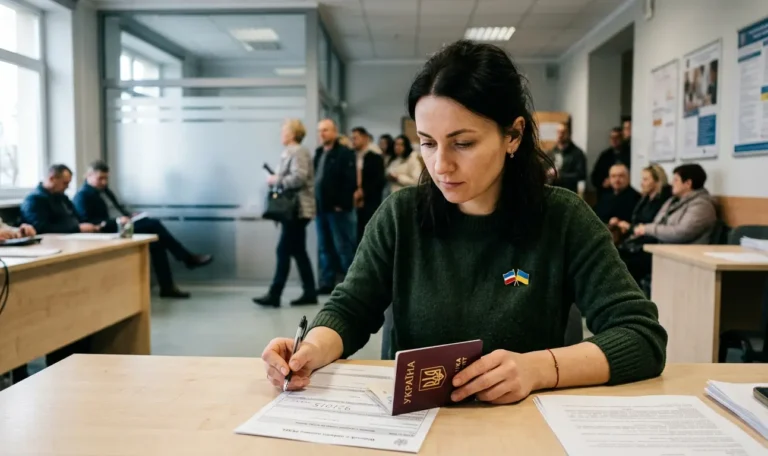
The situation is different for those who have been registered solely on the basis of a statement of identity, without showing a passport. In this case, you have until 31 August 2026 to confirm your identity at any municipal office by showing a valid travel document. Failure to do so will mean the loss of the UKR PESEL and, in practice, the loss of temporary protection from 1 September 2026. This is one of the most important dates in the whole new system.
In practice, it is a good idea to address this earlier rather than at the end of August. The closer the deadline, the greater the risk of queues, mistakes and stress. One visit to the municipality can determine continuity of residency, access to work and the possibility of later switching to other, more stable grounds for legalisation.
In addition, persons who have obtained a PESEL on the basis of another document (which has expired) have 60 days from the date of issue of the new travel document to confirm their identity.
Extended residence permits - what has expired and what remains
Separate attention is required for Ukrainian citizens whose residence or validity of their residence permits were previously extended by operation of law under the special law for Ukrainians. The law of 23 January 2026 maintained these extensions until 4 March 2027. - but not all of them. The extensions for leaving Poland after a decision to refuse or revoke a permit and the extension for voluntary departure from a decision on an obligation to return have expired. Individuals in this situation must act immediately.
It should be emphasised that the extended documents confirm the legality of the stay in Poland by law, but, as a rule, they do not entitle to cross the border.
When can UKR status be lost?
The new rules also sort out situations in which temporary protection lapses by operation of law. This is very important, because not every loss of status is due to negligence. Sometimes all it takes is one life decision or a poorly planned departure.
The UKR status may be lost, inter alia, if the departure from Poland lasts longer than 30 days, if another basis for residence in Poland is obtained, if temporary protection is obtained in another EU country or if a change of legal status occurs which excludes the further use of temporary protection. Planning for mobility abroad therefore remains of great importance. This applies both to family trips to Ukraine and professional stays in other countries.
This is why, when planning to work outside Poland, it must not be assumed that entitlements based on the Polish UKR status automatically transfer abroad. When posting workers, it is worthwhile to analyse residence and labour issues in the host country in parallel. This issue is discussed in more detail in the texts on the Van der Elst visa procedure and on the posting of drivers to Germany. In many cases, it is the correct planning of the departure that determines whether there will be an irreversible loss of status in Poland.
CUKR card - the most important pathway for those who want to stay in Poland for longer
The biggest change of strategic importance is the preparation of a pathway to the CUKR residence card, i.e. a three-year temporary residence permit for persons previously granted temporary protection. This solution is very important, as it allows to leave the temporarily prolonged UKR status and move to a more classic, stable basis for the legal stay of Ukrainians in Poland.
The CUKR card gives full access to the labour market without an additional permit and without the obligation for the employer to report employment to the labour office. It also allows them to carry out business activities on the same basis as Polish citizens, to travel within the Schengen area for 90 days in any 180-day period and to count this stay as part of the period required when applying for a long-term EU resident's residence permit. It is this last element that is of particular importance to many people - residence on the basis of the CUKR begins to build long-term stability in real terms.
Conditions for obtaining the CUKR card
To apply for a CUKR card, statutory conditions must be met, including having a current UKR PESEL on the date of application, also having it on 4 June 2025, retaining it until the date the card is issued, and demonstrating continuous UKR status for at least 365 days. UdSC also confirms that the application will be available until 4 March 2027.
Privileges and risks associated with the CUKR card
However, it is important to remember that the CUKR card is not just about privileges. The moment you collect it, you lose your UKR status. In addition, leaving Poland for at least 6 months results in cancellation of the card, and failure to collect the document within 60 days of notification by the office may lead to cancellation of the card and loss of permit. This is a very beneficial solution, but one that requires an informed decision.
Are CUKR and MOS already in operation?
This question arises very frequently today and requires a precise answer. The CUKR path itself is already provided for in the legislation and described in detail by the UdSC. However, this does not mean that applications can already be freely submitted in practice. The UdSC and the provincial offices indicate that the procedure is to be carried out exclusively electronically via the MOS portal, and work is nearing completion on its full launch. At least 14 days before the launch, a communiqué from the Minister of Internal Affairs and Administration is to be published with the exact date of the system's launch. Until then, a paper application for CUKR cannot be effectively submitted and provincial offices do not accept such applications.
The MOS itself already exists as the UdSC portal and is used for obtaining information and preparing residence applications. At the same time, the UdSC points out that the full electronicisation of all procedures is being implemented in stages, and that in some cases further steps are still necessary at the office. In practice, this means that it is advisable to prepare documents and organise data now, but it must not be assumed that every procedure can be completed online only today.
Access to the labour market - still broad, but needs to be guarded by formalities
After 5 March 2026, Ukrainian citizens under temporary protection can still work in Poland without a work permit. However, the key obligation on the part of the employer remains - to notify the district labour office within 7 days of starting work, exclusively through the portal praca.gov.pl. The new legal basis for this obligation already stems from the Act on the conditions of permissibility of entrusting work to foreigners.
Transitional period until 4 March 2029.
Importantly, a three-year transition period is also indicated. Ukrainian citizens legally residing in Poland will be able to work on the basis of the notification also after the end of the temporary protection, until 4 March 2029. This solution is of great practical importance, as it gives more time for a smooth transition to other residence and work bases.
More broadly, the topic of labour market changes is worth reading alongside the reform of the entire migration system. Therefore, a good complement to this article is our analysis: Legalisation of foreign workers in 2026. - What the Migration Pact changes in real terms. This makes it easier to see that the changes concern not only Ukrainian nationals, but the broader model of employing foreigners in Poland.
How to plan the coming months sensibly?
After 5 March 2026, the most important question is no longer whether the protection still works, but how to make good use of the time left until 4 March 2027. For some, the priority will be to confirm identity and maintain UKR status. For others - preparing for the CUKR pathway. For yet others - to check that the employment, exit and documentation model is secure for the next few years too.
In practice, it is worth doing three things as quickly as possible. Firstly - establish on what basis the UKR PESEL was assigned. Second - check that all the data in the registers is up to date. Third - plan whether the target solution is to stay with UKR until 2027, apply for CUKR or switch to another residency basis. The earlier such analysis is done, the more options remain realistically available.
Need help assessing your situation? Feel free to contact us
Every residence history looks different. The changes effective from 5 March 2026 in many cases require individual assessment, both in terms of residence and work of Ukrainian citizens in Poland. If you want to make sure what rules apply to your situation and what actions are worth planning, contact our law firm.
We can help you analyse residency, labour and cross-border issues and prepare a secure strategy of action for the months ahead.